
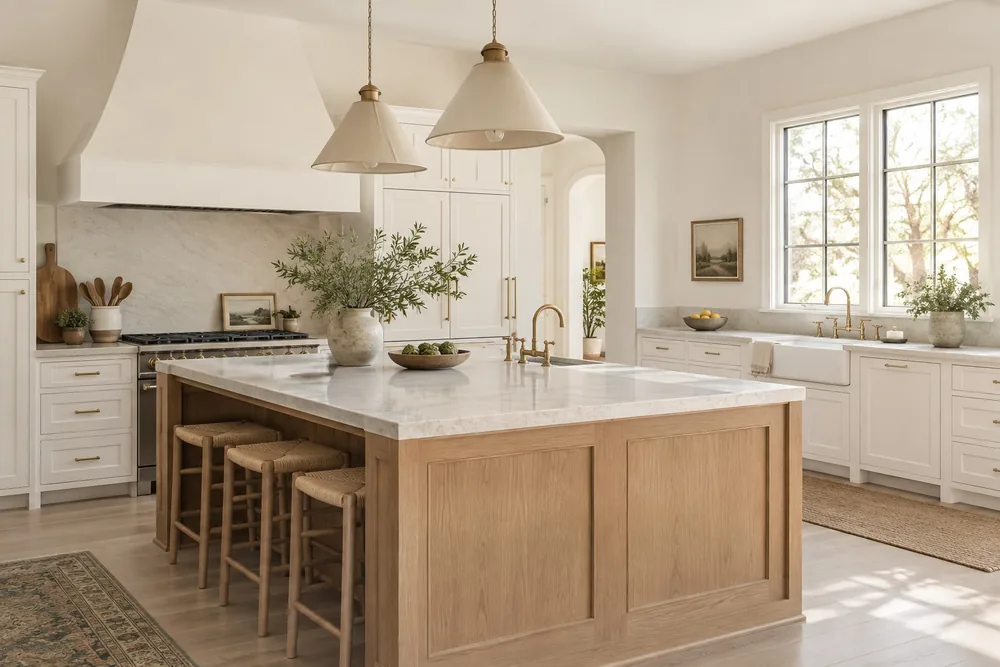
Give the paint a defined role
Build a Soft Chamois palette around the fixed surfaces first. This review explores limestone and unbleached cotton, with separate choices for trim and a smaller accent. Soft Chamois offers a shaded warm-white appearance rather than the strongest possible white contrast.
Limestone and unbleached cotton can support that softness, but the existing ceiling white sets a separate boundary that should be kept visible.
Named color references and material roles
Use the largest permanent white or cream surface to organize the Soft Chamois palette. Decide whether the wall should closely repeat it or separate visibly. Add a colored accent only after the whites agree; an attractive accent cannot repair a continuous mismatch between wall and cabinetry.
The manufacturer's coordinating suggestions include Tapestry Beige OC-32, Saybrook Sage HC-114 and Annapolis Gray HC-176. These are separate named colors to sample, not interchangeable formulas. For the material direction considered here—limestone and unbleached cotton—choose which surface each candidate would occupy before deciding that the whole set belongs in the room.
| Palette element | What to decide |
|---|---|
| Main paint | Soft Chamois OC-13 |
| Material direction | limestone and unbleached cotton |
| Reference candidates | Tapestry Beige, Saybrook Sage and Annapolis Gray |
The condition for keeping Soft Chamois
Compare it with the actual ceiling white so the subtle warmth reads as a coherent layer. The undertones and neighboring colors covers that related choice.
Use unequal sample areas: a broad Soft Chamois board for the main painted surface, a narrow trim strip and a smaller accent. Equal chips can exaggerate the role of a color that will occupy little of the room. The wood-floor pairing guide covers that related choice. Before ordering samples, compare room-planning features in the paint color visualizer roundup.
Sources & notes
Color specifications: Benjamin Moore Soft Chamois OC-13. The recorded LRV is 77.4. Named comparison values come from the respective manufacturers; material schemes are editorial suggestions.
This guide reviews published color information and proposes practical sample checks. It does not claim first-hand paint testing or customer-review scores. Benjamin Moore does not sponsor or endorse this site. Product names and trademarks belong to their respective owners. Confirm the color in a physical sample and select the coating for the actual surface and finish.